Tuesday, April 10, 2012
Seeking Challenges
The life of a church worker is filled with challenges. As such, people in this line of work tend to avoid situations where their perspectives, attitudes, and priorities are questioned. This has certainly been the case for me. The only small groups / classes / Bible studies I am part of at the church are ones I lead. Even though different viewpoints arise during these gatherings, as the leader I am able to guide the conversation in certain directions. I get to prepare activities and discussion questions that move the dialogue along a path of my choosing.
So, it is with a great amount of curiosity and a twinge of nervousness that I am becoming a "regular" member a church group. An early-morning men's Bible study, to be specific. The group consists of 10-12 guys, none of whom are within twenty years of me. To be honest, this is not a small group (nor a meeting time) that I would typically be drawn to. I've worked at this church for nearly nine years, and until last month, I had never attended these meetings.
Why now?
It's time for me to step out of the role of leader and be surrounded by a very different demographic. I need to be immersed in the wisdom that only comes from people who have lived longer than me. It's important for me to step out of the echo-chamber of ideas that reinforce my understanding of the way the world works and seek challenging, new perspectives. I need to wrestle with difficult questions as just-one-of-the-guys, and not as the person who is expected to have the answers. I need to humble myself a little (or a lot) and realize the ways in which I need to grow as a disciple of Jesus Christ.
Today was the first day I attended this group as a member. Though the texts we studied were familiar -- Doubting Thomas and Early Christian Community -- the insights offered by these intelligent, well-read, faithful, curious, wise men brought something new to my (albeit limited) understanding of who God is. It's a blessing that this group eagerly invited and graciously received me as a fellow participant.
The discussion was lively and fascinating...and so important to me that I'll be waking up far too early again next week to do it all again.
Monday, April 9, 2012
Bubbalicious
The reasons I rooted for Bubba Watson on Sunday were numerous, and included:
- the pink driver
- lefties unite!
- I felt bad after he choked away the 2010 PGA Championship - the last time his dad saw him play golf before dying of cancer
- "Oh, Oh, Oh"
- his last name is easier to pronounce than Oosthuizen
- he and his wife just adopted a baby two weeks ago
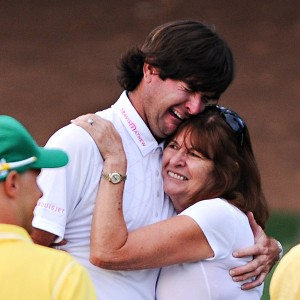
Bubba won the 2012 Masters in spectacular fashion, with a stunning second shot (140 yard snap-hook wedge from the pine trees) on the second playoff hole. He was a wreck after he won, bawling in the arms of his caddy and mother on the #10 green as ole Oostie waited patiently for the post-match handshake.
This morning, I found a new reason to like The Bubba -- it seems he has never taken a golf lesson. Though the veracity of this claim can be debated, it does add a bit of intrigue to the narrative. Furthermore, it makes me wonder if Bubba's autonomous learners approach to golf is part of what makes him so colorful and quirky, or if it's indicative of how 21st century young adults learn their craft.
Most golfers employ several swing coaches throughout their career. Many of them have been playing since they were old enough to walk; products of over-bearing (wealthy) parents, local golf pros, summer-long instructional camps, and national academies. Every golfer has received hours of instruction - formal and informal - on the how to master the myriad technical aspects of the game.
Not Bubba.
Is he naturally gifted, and therefore can eschew any sort of formal training? Did he lock himself in a room and watch thousands of hours of old golf footage and go out and mimic the swings of the great golfers? Did he just practice more/harder than anyone else? Did he actually take "lessons" by playing a lot of rounds with golfers that gave him pointers?
My guess is that there are a bunch of Bubba's sprouting up in companies around the world. Scruffy-looking young people with no formal training who possess the potential to transform the way business is done. If I had a stake in institutional hierarchy and the preservation of formalized education, I'd be nervous every time a young punk like Bubba Watson (or Mark Zuckerberg / Steve Jobs, for that matter) ascends the ranks. When these people succeed, it renders formalized structures a little less important...a little less powerful...a little less essential.
Monday, February 20, 2012
Wholeness & Holiness
Some you are aware that I'm working on a "purity curriculum" project with Ritva Williams and Jake Bouma. Our collective foray into the land of self-publishing has been a fascinating process. Our product unofficially launched at the 2012 ELCA Youth Ministry Network Extravaganza in New Orleans in early February. Though we are still a few months away from unleashing the finished product, I was able to share Wholeness & Holiness samples, images, and concepts with youth ministers and pastors throughout this event. (Jake was supposed to attend, but he had to stay home.)
The key image of the Wholeness & Holiness curriculum is a body outline. Throughout each session, students draw an image on a "body map" as a way to reinforce the gist of the lesson.
Wholeness & Holiness had a table in the exhibit area...which was, essentially, a narthex near the large gathering space for general sessions. It was fun to visit with people about how they approach conversations about sexuality, marriage, and purity in their congregations.
Most people expressed dissatisfaction with traditional purity resources, indicating they were (a) too narrow in their interpretation of Scripture, (b) too awkward in how it approached the topic with teens, (c) judgmental and legalistic in their tone, or (d) used a cherry-picked small collection of verses to fit a particular worldview.
For these, and other, reasons, many people initially kept their distance from the Wholeness & Holiness booth. My interpretation is that people saw "purity curriculum" in the promotional materials and didn't want anything to do with their pre-conceived notions of what that meant. Over the course of the five days, people began stopping by the booth to ask questions about materials or to add their input to the question "When you see or hear 'purity' what comes to mind?"
By Day 3 there was a steady stream of people who were excited about resources that offered a more comprehensive approach to the topics of sex, Bible, and purity. One of the things that I became most excited about was the idea of using Wholeness & Holiness beyond confirmation or youth group settings. What if adults spent eight weeks discussing what the Bible really says about the various understandings of purity? Furthermore, how might the word "purity" be reclaimed in Christian circles to be more than "don't have sex until you're married" and explore the dozens of other Biblical texts that pertain to how people interact with each other and with God.
I'm grateful for the work of my collaborators, and for my friends -- Ellen, Megan, Anne, Mark, Eric, and Todd -- who went out of their way to help set up the booth and promote these resources at the Extravaganza.
If you'd like to learn more about the upcoming release of Wholeness & Holiness, or you're interested in having conversations about biblical purity, feel free to connect in these ways:
Wednesday, January 4, 2012
Read All About It
Something that has endured thus far, however, is the concept of an e-newsletter that shares articles we like. We're calling it Recommended Reads.
Recommended Reads is a twice-monthly email that contains links to five articles you may have missed. We scour the depths of the web and hand-pick articles that spotlight creative voices with unique perspectives on religion, culture, and ministry.
Nobody wants to be inundated with a barrage of e-junk that clogs up inboxes and never gets read. However, we think that people might find value in being directed to a handful of thought-provoking articles every couple of weeks. At least we hope so.
Jake and I plan to send a new issue of Recommended Reads on the 2nd and 4th Tuesday of the month, starting January 10, 2012.
CLICK HERE to subscribe to Recommended Reads.
Blessing the New Year
New Year's Eve 2011 landed on a Saturday, which gave me an excuse to try something new at church. We offered a Festival of the New Year which included worship, supper, board games, puzzles, karaoke, and a late-night blessing.
Each family was given a biodegradable sky lantern to decorate with their hopes for 2012. Some wrote with words, others drew pictures.
Prior to igniting and releasing the lantern, our pastor offered this prayer:
Another year has turned its page, O Lord.
We feel promises about to be fulfilled, hopes that may be realized,
And sorrows unknown – that may become ours to bear.
All of this, we carry into a New Year.
We declare at the doorway into this year, that our trust is not
In any man or woman to fulfill us,
Nor is our trust in circumstance,
Or a belief that the days ahead will be easy.
We do not expect, in this New Year, for our every prayer
To be answered in a way we would like.
You are in control, and we release our lives to you.
To be answered in a way we would like.
You are in control, and we release our lives to you.
We then proceeded outside and sent one lantern at a time up into the sky. As the Ullestad family lantern floated away, a Christmas lyric kept running through my head...
"The hopes and fears of all the years are met in Thee tonight."
Happy New Year everyone.
Tuesday, January 3, 2012
Iowa Pride
For many of us, this is a day when we rejoice in our newfound freedom from political surveys, phone calls, and advertisements. It's also a day when we receive a disproportionate amount of praise and criticism as the unofficial launching pad of the 2012 Presidential Campaigns.
I love living in Iowa. I've had several opportunities to leave in recent years, but I can't imagine living anywhere else. (For two years I lived in Illinois, but my wife worked in Iowa and we spent most of our free time West of the Mississippi.) That isn't to say I don't occasionally dream of moving to places like Denver, Portland, or Chicago...but I don't think I could ever leave.
A group of filmmakers made a clever (albeit, crass) video extolling some of the great things about Iowa. For example:
- The first female lawyer in America came from Iowa in 1869
- 4 out of 5 Iowans live in the city
- 1 Iowa farmer feeds 155 people
- The average Iowa farm is larger than 300 football fields
- Iowa has the 6th lowest unemployment in the nation
- Des Moines was ranked the richest metro in the country, and the 2nd happiest
- The computer was invented at Iowa State University
The video, as well as dozens of other pro-Iowa articles, have likely been in response to an unfortunate piece written by Stephen Bloom in The Atlantic online a few weeks ago. An essay that had lots of helpful observations, but was mired in inaccuracies and unnecessary generalizations.
For my part as a resident of the Des Moines metro, I appreciate the quality education my children receive at public schools, reasonable cost of living, increased ethnic and religious diversity, and progressive business strategies that attract new companies in the area. We don't have to drive far to spend a day in the country; nor are we more than a few hours away from major cities. Yeah, the weather sucks at times and I wish we had a professional sports team. But our housing bubble didn't burst in the last few years, we can get anywhere we need to be in 15 minutes, and I can go to a Farmer's Market almost every day and talk directly to the people who grow the food I eat.
Iowa is a pretty sweet place to live. I'm proud to call it home, and I'm happy that (at least once every four years) millions of other people get to see how special it is to be an Iowan.
Thursday, December 8, 2011
Poor Children
I posted this quote on my Facebook page just to see what my friends (many of whom are pastors, teachers, and social workers) thought. Within a couple of hours, over 30 responses - many of them lengthy - were posted. Some expressing agreement with the statements, most expressing outrage and incredulity.“Really poor children in really poor neighborhoods have no habit of working, and have nobody around them who works. So they literally have no habit of showing up on Monday. They have no habit of staying all day. They have no habit of ‘I do this, and you give me cash’ unless it’s illegal.”
A brief exchange on the Tony Kornheiser radio program articulates my feelings on the matter.
Kevin Sheehan- Newt Gingrich is the front runner now in a lot of polls...in Iowa. He said something last week that I know you, Tony, wanted to respond to. He said the following [reads quote]:
Tony Kornheiser- That’s a pretty broad brush that he uses to paint. I have no doubt that is occasionally true in some households, but I think that it is also true in wealthy households too. I just think it is more true that people go out and try and work and do the best that they can, and often, because of a lack of money, have to take public transportation long distances to work. I think that’s an unfortunate statement. I think you can defend it by finding some miniscule amount of people who do that, but I don’t know how that helps you get votes.
Gary Braun- You don’t think there’s some people who hear that, and are like “YEAH!”?
David Aldridge- Dog Whistle, Tony. Dog Whistle. It’s all about appealing to your base. And Newt’s base of conservative voters wants to believe the story that poor people are poor because they chose to be poor, and all they want to do is...
Kornheiser - ...lie around heaven all day...
Braun - ...suck off the government teet....
Aldridge - Yes, and that’s the narrative that they want to believe. And so, he feeds them that narrative.
Speaking in generalities is dangerous, especially when it's a wealthy adult describing the circumstances surrounding poor children. Though I believe that our political system is broken beyond repair, I hope that there can be some civil discourse in the next year surrounding issues of poverty, hunger, and education.
For additional information about children in poverty, consider exploring these web sites:
Fight Poverty
National Center for Children in Poverty
Change
ELCA - Hunger & Poverty
Subscribe to:
Posts (Atom)